
Travel Tips USA Today: Visiting Maccu Piccu
Called Old Mountain by the Inca people who built it, Machu Picchu draws hundreds of thousands of tourists each year. The ancient Peruvian city is located at nearly 8,000 feet above sea level, and although it is close to the equator, the weather can vary from chilly and rainy to dry and parched. Planning the trip at the optimal time can make the visit more pleasant and less stressful.
Background
Machu Picchu was founded in the fifteenth century by the Inca. The Inca Empire dominated the central Andean region of South America for nearly 400 years and was known as great architects and road builders, among other attributes. The city was abandoned by the Incas and was later rediscovered in 1911. Today it is protected by the Peruvian government and has been named a World Heritage site by UNESCO, and because of the large amount of tourists who visit the area, it is closely monitored. All visitors must be accompanied by a certified guide, and there are only four ways to get to the city: hike the four-day trail or take a train, bus or helicopter.
Weather Conditions
Although equatorial South America is known for steamy rainforests, the high altitude of Machu Picchu makes for much milder temperatures. The average temperatures range between 50 and 85 degrees Fahrenheit with only slight variations throughout the year. The subtropical region has an annual rainy and dry season, but Machu Picchu is almost always surrounded by fog in any weather. November to April is the rainy season, although daily short showers are common most times of the year. Peak tourist season corresponds with the dry season in July and August when the nights are cool and the days are generally dry. January and February are the rainiest months, and many people visit the area in November and April to avoid the heaviest crowds.
Avoid the Crowds
Weather influences much of the heavy tourist trade in the Machu Picchu region, but there are other factors. Avoiding the time period that most schools and colleges are on break is a good idea. If less than ideal weather isn't an issue, planning a trip in the rainy season is a possibility, too, but be aware of closing dates and extreme weather conditions. Any time of year, mornings are usually less busy, and hiking the Inca Trail rather than taking a bus or train is also an option.
Special Considerations
Although it is tempting to travel to Machu Picchu at the heaviest part of rainy season, there are a few things to consider. The Inca Trail is closed the entire month of February because of possible hazardous conditions. Although other routes are open, roads and passes may be closed suddenly because of landslides and flooding.
Tips
Planning a trip to Machu Picchu in the rainy season requires flexibility and patience. Weather conditions can change suddenly, so an alternative plan to visit other area sites can ease frustrations. Buy tickets well in advance in the peak season to avoid being turned away from transportation and don't forget the sunscreen no matter what season you visit.
Rediscover Maccu Piccu: Visiting
How and When is Best to Visit Machu Picchu?
After taking the decision of travelling to the location, the first questions a traveler asks it how to get there and when is the best time of the year?
We are trying to answer to these basic questions to help you plan your Machu Picchu trip!
This resource will take you through all main issues and aspects.
Getting to Machu Picchu
You have 2 main choices:
 Hike the Inca Trail by booking at least 3 months ahead at an agency
Benefits: see wonderful scenery and other Inca ruins; get to Machu Picchu before other travelers
Risks, Difficulties: medium difficulty level; cannot do individually, must book from an agency
- You will have to book either online or locally in your country at an agent who sells such packages. Local agencies inCuzco and Lima also offer "Inca Trail to Machu Picchu" hiking packages.
- Access to the trail is limited, certain numbers of tourists are allowed to pass during certain periods (numbers are subject to change).
- Individually you are not allowed to go through, only with organized groups.
- If you book for such a trip from an agency, then you will be guided by authorized English-speaking guides and will get to know other travelers as well.
- You need acclimatization, must get used to height level, therefore you should stay at least 7 days in Cuzco before taking the trip. Hiking experience and a thorough medical checkup is necessary before taking on the ancient Inca Trail.
- Our Inca Trail to Machu Picchu hike article will give you further information and advice on getting prepared.
Take the train from Cuzco to Aguas Calientes and from there by bus or on foot all the way up to the ruins
Benefits: doable in 1 day; cheaper
Risks, Difficulties: expect crowds of tourists; possible access limitation to some parts of the city
- The easy way is cheaper, but less fun. As it is in life in general or the road to Mecca (in Muslim philosophy).
- If you are travelling with your family, then this is the only way.
- Trains leave from Cuzco and arrive at Aguas Calientes. Buses go up to Machu Picchu from there. Prices and schedules are presented below this phrase, but keep in mind that they can change at any time!
Cuzco to Aguas Calientes Train
- The distance between Cuzco and Aguas Calientes (Machu Picchu Pueblo) is 112 km (70 mi). The duration is approximately 4 hours and the scenery in the Sacred Valley is breathtaking.
- There are 2 train stations in Cuzco: the trains to Aguas Calientes leave from the San Pedro Station (located at the Calle Cascaparo).
- There are 3 trains that will take you from Cuzco to Aguas Calientes: Hiram Bingham, Vistadome and Backpacker. The prices are highest on the Hiram Bingham train and lowest on the Backpacker train.
- Check the Machu Picchu train schedule for further details.
Aguas Calientes to Machu Picchu Buses:
The departure time of the 1st bus is at 5 AM.
The price of a single trip is approximately 5 - 6 USD.
The Best Time for Visiting Machu Picchu
Due to its location in the Andes where precipitation levels are high, the mountains around swim in dense fog and receive heavy rain most of the time every year.
If you want to clearly see Machu Picchu as it is in photos, then you will have to travel there when there's less precipitation.
 The best time to visit Machu Picchu is in the April - October interval
Rain still occurs, fog is frequent, but you have the best chance of seeing it in its full splendor.
The period when most travelers arrive is in June - August
This time of the year there are large crowds of tourists, one can hardly get around in some parts of the site, lines are formed at the entrance. Most of the travelers are arriving through Aguas Calientes (Machu Picchu Pueblo), fewer will hike the Inca Trail, which is the harder way.
Where to Buy Entrance Tickets to Machu Picchu?
There are 2 ways to buy tickets:
Buying the Machu Picchu entry tickets in Cuzco
Location:
Instituto Nacional de Cultura, Avenida Pachacútec, Cuzco (close to the Plaza de Armas)
Buy the tickets in whole when booking for a trip from an agency
Normally they should sell you the tickets when you book for the Inca Trail hike or even if they sell you guided tours with train and bus tickets included.
The average price of a Machu Picchu train ticket is about 43 USD.
Practical Advice for Visiting Machu Picchu
After you have understood when and how you can reach the spot, some advice will be useful on how to better enjoy the city. First of all think about why exactly you want to visit it and what you would like to see.
Certainly our advice below will be of good use to many of you...
Advice for Photographers
In order to catch the best sunlight and avoid fog and crowds, we advise you to travel the following way, if you have hiking skills and feel ready for going through the mountains.
If you want to take the easy way and still get a good glimpse of the city, then you will have to travel by a combination of train and bus or train and then on foot to Machu Picchu.
In this case...
Get the train from Cuzco to Aguas Calientes and then stay several days at a hotel in the town. Stay several days there at a hotel and get up to Machu Picchu in the morning before other tourists with the help of local Quechuan guides who know good shortcuts through trails all the way up to the site
Please note that if you walk from the town to the ruins, it can even take 2 hours if you're well loaded and not used to physical effort. The Aguas Calientes - Machu Picchu distance is 8 - 9 km (5 mi) approximately. Count for at least 1 hour duration.
What to Bring and what not to Bring to the Ruins?
There is a luggage storage place/office where you can leave your luggage on the mountain top at the entrance to the archaeological site. You will have to leave your large bag/large backpack there, only small carry-on luggage and items, such as cameras, tripods are allowed inside.
Make sure not to leave any valuables in the luggage, if you decide to leave it at the left-luggage office.
Drinks and food are not allowed to be taken in to the ruins.
Portable music device with earphones, they will distract your attention from the sight, the smells, the sounds, winds up there... These kinds of items are better not to be taken to the ruins.
Before departing, you might need to use insect repellant crème or spray on yourself due to the fact that mosquitoes and other insects roam in the humid warm environment.
What to Wear - Preparing for Rain, Fog, Cold
Sometimes temperatures go very slightly below 0º C (32º F), maximum temperatures are around 20 - 22º C (69 - 70º F). All these in the "adequate period for visiting".
Variations of temperatures and moisture levels are intense. Make sure to prepare for very hot and very cold, but be prepared for moist as well.
During the dry season (April to October), one should expect night-time lows of 0º C (32º F) and daytime highs reaching 26º C (78.8º F)
There is 77 % humidity during the dry months and up to over 91 % during the rainy months. This does not mean rain necessarily, but air humidity, water vapor and myst.
Humidity is high, so make sure to bring impermeable clothes, a raincoat.
It is a general rule that days are warm and nights are ice-cold.
Comfortable impermeable boots are recommended for footwear. The grass is often wet, there's mud and pebbles, small rocks, even if you don't hike, you should take boots. If you do hike, it's a must.
If you are going to hike to Machu Picchu, then get help for preparing accordingly.
Parts with Limited Access
The Huayna Picchu Cliff is visited only by part of those who enter the site. Some don't know about it, others don't get there in time.
The entrance to Huayna Picchu is usually closed after 16:00 o'clock, but you might find the access blocked before if there are many visitors.
For getting access to Huayna Picchu, we recommend you to get up very early in the morning and arrive there by 6 o'clock.
How to Get the Best out of a Visit to Machu Picchu?
It's very important to check the weather reports, no matter how you choose to get to the spot. Regardless of what the weather report will tell you, keep in mind that the earlier you arrive, the colder and the wetter it will be up there. Always bring impermeable clothes, like a thin raincoat.
In order to best enjoy the views of Machu Picchu and avoid the large crowds, we advise you to get there through the Inca Trail. Most itineraries take 4 days of effort and high costs, but you will get to see the wonderful city by passing through Intipunku (the Sun Gate) before the large crowds, with luck you will even have fine weather.
Plus: you will see a number of other ruins along the trail and get glimpses of Machu Picchu from unusual angles that others will not see.
When in Machu Picchu, make sure you climb the peak of Huayna Picchu, from up there you can admire an unforgettable view over the main quarters of the city below.
Don't hurry, enjoy the splendor of the ancient Inca city!
Make sure you have a very good camera with you and some spare accumulators/batteries. Immortalize the magic moments in the dreamlike city.
What is Inside Machu Picchu?
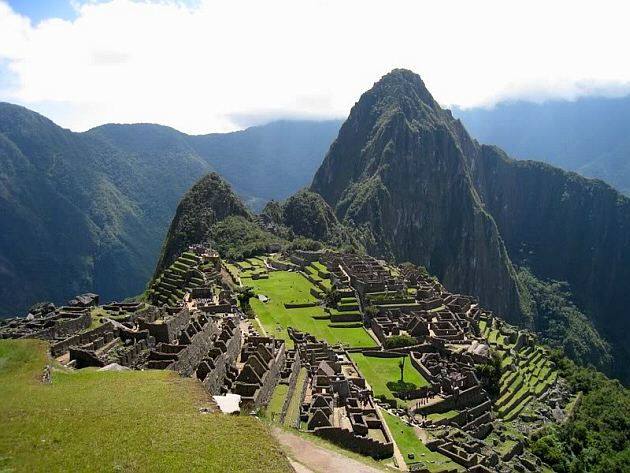
Machu Picchu in all its splendor
The city is a complex of over 200 dwellings, most of them houses, some of them interesting temples. You will also see caves, a park, agricultural terraces, waterways, fountains, a rock quarry (where the construction materials were extracted).
The entrance is just below the agricultural terraces and you will enter to the city from slightly higher ground.
Behind the main parts of the city you will notice the high abrupt cliff, which is called Huayna Picchu or Waynapicchu. You can even climb up to Huayna Picchu. From there, you can admire the wonderful view over Machu Picchu from above!
This is an experience that most tourists don't even try out.
"Machu Picchu" means "Old Peak", "Huayna Picchu" means "Young Peak".
Why is Machu Picchu Special?
It is special in many ways. Very special!
It is probably the most beautiful ancient city in the World!
The views are spectacular, the layout of the city on top of the flattened plateau is unusual. Remote, yet well-placed.
It is one of humanity's greatest wonders, it's on UNESCO's World Heritage List and has been voted one of the New 7 Wonders of the World!
If you want to find the most special place in the World that you must visit at least once during your lifetime, then take our advice: pick Machu Picchu!
UNESCO placed it on its World Heritage List in 1983 and in 2007 it has been voted into one of the 7 New Wonders of the World!
The only intact Inca city in the World!
The conquistadores never found it, so it remained unharmed... Machu Picchu has the only sacred Intihuatana Stone that wasn't destroyed and all of its buildings have remained untouched.
It is the only Inca city that survived so in perfect shape!
Entering Machu Picchu
We recommend you to check out advice on visiting Machu Picchu for understanding how to get there and how to get entrance tickets.
Entry into Machu Picchu can be done through 2 entrances, both presented below...
Intipuncu/Intipunku (Sun Gate)
Only those who take the hike to Machu Picchu have the possibility to pass through this unique gate, called "The Sun Gate", which is located on the edge of the Agricultural Sector.
The view is very beautiful in the morning, when the Sun comes up. It is a rewarding experience to see for those who hiked all the way to the ruins!
Main Entrance
This is where most travelers pass through when entering Machu Picchu.
Near the entrance you will see a luxury restaurant and a luxury hotel (Machu Picchu Sanctuary Lodge Hotel).
If you will be arriving through Aguas Calientes (Machu Picchu Pueblo), then you will pass through this entrance.
The Layout of Machu Picchu: Sectors and Districts
Some might call district what others call sector.
On our site the word district means a well-defined part of the urban part of Machu Picchu, in other words, an inhabited area comprising of buildings. While, the word sector in our articles, refers to the 2 main parts of Machu Picchu: the agricultural area and the urban part. As you understand now, (only) the urban sector part (Urban Sector) is divided into districts.
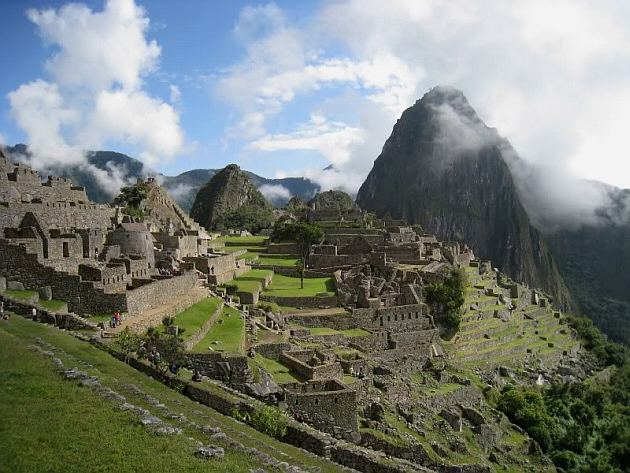
Machu Picchu, as seen from the agricultural terraces
The Agricultural Sector
Located in the southeastern part, it comprises mainly of agricultural cultivation terraces, which were also equipped with watering installations (aqueducts).
There are several other elements than just the terraces in this sector. There is a Guard Hut, a Cemetery, a Funerary Rock and the City Gate (not to be confused with Intipunku/Intipuncu or the Sun Gate).
The agricultural terraces have 120 steps (terraces). The upper part has 40, the lower section has 80.
It is not allowed to jump and run on them, so don't allow yourself to be carried away. The authorities are putting a lot of effort into conserving the citadel as well as possible!
The height of the terraces varies. Some of them are up to 4 m (13.12 ft) high. And some of them are right above the deep Urubamba Valley.
The terraces have been constructed rather on the mountain sides than on the top.
The Inca Trail to Machu Picchu leads from the mountainous areas right into the Agricultural Sector. This is where the hikers enter the city.
The Urban Sector
Occupies the biggest part of Machu Picchu and is situated northeast of the agricultural sector.
It is the the part richest in attractions in the whole of Machu Picchu. This is the core of the city. Most houses and temples are located in the Urban Sector.
Guide of the Agricultural Sector
Some tourists overlook this part of the city, because they consider that it is less important than the Urban Sector.
There are several attractions that you mustn't miss seeing.
The Guard House/Watchman's Hut (Casa del Vigilante)
This is the most prominent construction located in a strategic place, on high ground from where the Incas could observe the Urban Sector and a large par of the Agricultural Sector.
The Guard House is sometimes called Watchman's Hut or House of the Guardians.
The view from up there over the city is very beautiful!
The Funeral Rock
It is right near the Guard House. You can't miss it, it's a huge stone.
Human remains were found near it, proving that burials were made in the proximity.
Some stones found nearby contain grooves, which could mean that they were used in sacrifices. Some specialists say that certain carvings in rocks were made for blood drainage or for placing human or animal body in it. Though, there is no concrete evidence that the Incas made human sacrifices in Machu Picchu, we know that animal sacrifices were very frequent and considered requirements by the gods in Inca religion.
The Urban Sector's Districts
The urban part of Machu Picchu is divided into 3 districts (sub-sectors, if you wish). These are the Sacred District (or Religious District), the Popular District, the District of Priests and Nobility (also called Royal District).
The names and labels used for the districts of Machu Picchu are diverse.
Even the districts can be divided into different parts. We will thoroughly present you these districts below.
The Popular District/Residential District
This is not the only residential area of Machu Picchu, but it is named like this, because most houses are located here. The lower class Incas might have had their homes in this district.
The buildings are simple houses and storage buildings in this part of Machu Picchu.
The Sacred District/Religious District
The construction of the Sacred District was motivated by religion. The Incas always had a special place in their cities for the mystical practices, rituals.
It is believed that the population periodically gathered in this area of the city and performed rituals.
This is where you will find the famous Intihuatana Stone, the Temple of the Sun, the Temple of the Three Windows. These two temples were both dedicated to the Sun God of the Incas, Inti.
The District of Priests and Nobility/Royal District
Some might call this district the Royalty Zone or Royal Sector. It is located between the Temple of the Sun (in the Sacred District) and the baths, close to the Sacred Plaza.
The high class Incas lived here. The rich, the leaders, the priests and possibly the emperor might have lived here too.
The houses in this part are located in rows, constructed on a slope. The Residence of Wise Persons (also called the Residence of Amautas) has distinguishable reddish walls. The zone of the ñustas (sort-of princesses, high-ranked young ladies) has trapezoidal roomed buildings.
There's even a jail in this part of the city. Prisoners were punished by placing them into rock niches.
This sector dedicated to the high level Incas has larger, roomier buildings, when compared to those in the Popular District, where the "normal people" lived.
There is a Main Building with a large stone object in its center was probably another temple. The rock might have been a table or altar. Some think that it was used for sacrifices.
Another building is the Monumental Mausoleum, which is a large stone block with carved walls and vaulted interior.
Guide to the Urban Sector
Those presented above might have created an image in your mind about the Urban Sector's main buildings and most importantly, information about its purpose etc. Now let's take a look at its attractions!
The Main Temple
It is located near the Temple of the Three Windows.
The building has partly intact walls, which are reclined, the stones moved out of place. The walls have niches in them. The Incas used these niches to place huacas into them. These were sacral objects.
The Temple of the Three Windows is a Wayrana-type (Huayrana-type) temple. This means that it only has 3 walls, built with rectangular stones.
It has 7 trapezoidal niches in its main wall and 5 on each sidewall.
The building lacks a 4th wall. Specialists say that it might not have been finished. It might be a sign of the fact that thepopulation had left, abandoning the city.
There is a rope blocking people from entering between the walls, where there is a grassy ground inside.
From the main temple, one can have a nice view over the Urban District.
The Temple of the Three Windows/The Three Windowed Temple
The building located near the hill where the Sacred Plaza is situated. The temple is clearly recognizable because it has 3 trapezoidal windows.
Interestingly, this buildings looks like it never had any roof. Or, it was fully made of wood and grass and had perished during so many centuries.
Chamber of Ornaments
This is a small room located behind the Main Temple.
According to scientists, the Chamber of Ornaments was a complementary building to the Main Temple.
A platform is found at the bottom of the "black wall". This platform looks like a stone bench or more like a stone bed, it is considered to be the "sacristy" of the Main Temple.
The Sacred Plaza
It is located on top of a natural hill. On that hill you will find the famous Intihuatana Stone.
Buildings nearby have the finest carved stones and are very carefully put together.
Religious rituals had taken place on the Sacred Plaza and the surrounding buildings. High level Incas would have attended these rituals.
Part of the hill still has rocks standing out of it, naturally. And, there are several terraces on the sides as well.
The view from the hill onto the city below is very beautiful!
The Intihuatana (Intiwatana) Stone
The exact purpose of this stone is not known. It must have been some sort of an astronomical or archaeological objects. Some specialists believe that it was used for determining the solstices by tracking the sun rays. When there was no shadow cast, then there was solstice (daytime equaled nighttime and the sun gets right above heads on midday).
As mentioned in many parts of our site, this Intihuatana is the only one well-preserved. All others were found by the Spaniards in the other Inca cities and were maimed or completely destroyed.
Unfortunately during the filming of a beer commercial in 2000, a crane has fallen on the Intihuatana, damaging it.
Some tourists think the rock has special powers and will fill them up with energy, therefore they put their hands on it.
The stone is surrounded by a rope fence and it is not allowed to climb it, step on it. However, it is generally allowed to put hands on it.
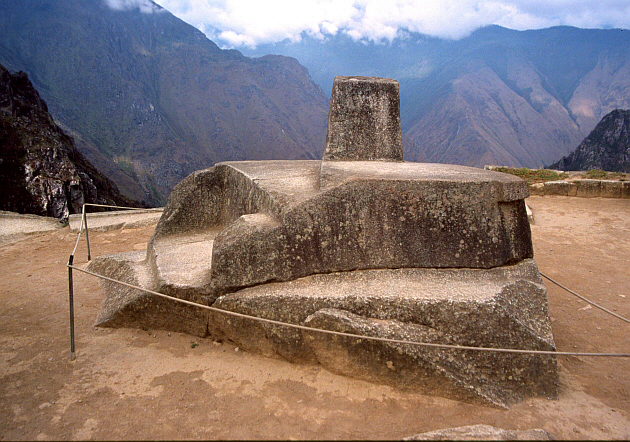
The Intihuatana Stone
The Temple of the Sun/Sun Temple
Semi-circular building located on the lower part of a hill, near the Ritual Fountains and the Royal Tomb, in the part of the Urban Sector close to the Agricultural one.
The temple could have been an astronomical observatory.
It is believed that high level Incas had their residences in this area.
It is not know exactly what rituals have been taking place in and around this temple. Some specialists that the main god of Viracocha would have been one of the worshipped ones.
Interestingly, here you will find stones that are held together by hardened mud. Atypical, because the Incas were famous for constructing with the dry stone technique.
You will see many photos of this temple. Its characteristic rounded walls are clearly recognizable.
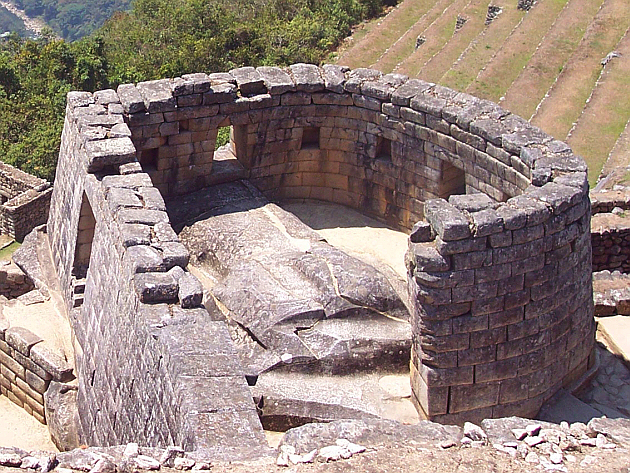
The Sun Temple
The Rock Quarry
It is located on a high hill in the center of the Urban Sector and has served for extracting the construction materials used for the buildings.
Still, scientists are speculating about how the blocks were extracted and cut.
The quarry was left there in the middle of the city. Another proof to the fact that Machu Picchu's construction wasn't finished and that the locals had abandoned it.
The Ritual Fountains
Fresh water for the population came from these fountains.
The water flows down in a cascade-like way, across several stone constructions.
The Condor Temple (Temple of the Condor)
According to the specialists, it was a torture chamber. But, tour guides will tell you that it was a simple "temple".
Between the stone-carved "wings of the condor", there is a chamber with grooves. It is believed that the grooves were carved in order to drive the flowing blood of the victim into the pit.
To the Incas, the condor was the symbol of cruel justice.
Some specialists consider that the Condor Temple was primarily used for animal sacrifices. And, probably it was never used for human sacrifices.
The Monumental Mausoleum
A stone block with a vaulted interior and carved walls.
This place too, is believed to have been used for sacrifices.
Guide to Huayna Picchu (Waynapicchu)
Many people don't even know that one can climb the high mountain behind Machu Picchu.
Most photos that you will see contain the high loaf-like mountain behind the Urban Sector. That is Huayna Picchu.
About 400 m (1,300 ft) higher than Machu Picchu and offers wonderful views. Climbing up there can be tiring, though.
Usually Huayna Picchu closes before 1 PM. You will have to hurry to get to the entrance (you will see signs saying "Waynapicchu").
The number of visitors is limited because already there are thousands visiting Machu Picchu every day. Authorities wanted to limit the number of those climbing to Huayna Picchu to 400 people a day. Although, the overall number is growing, this might not be a realistic plan.
On a busy day there will be 400 visitors long before 1 PM. Often, the limit of 400 will be reached long before 1 PM, at around 9 - 10 AM, so if you want to be sure to see it, then hurry to get there early and try visiting Huayna Picchu before the rest of the city.
Also important to keep in mind: those already on the Huayna Picchu Peak will have to leave at 4 PM.
There are stairs leading up to the "Young Peak". But, in some places you might have to walk on feet and hands as well. The terrain is difficult on some sections o the climb. There are steep steps and on higher levels there is rough ground.
The air is getting thinner, you should stop and rest for a while, several times, before continuing.
You will encounter ladders and ropes on which you will have to hold on to.
The hardest ascent is on the last 20 m (65 ft).
Climbing to Huayna Picchu takes 1 - 2 hours in general.
Make sure that you have very comfortable hiking shoes/boots.
On Huayna Picchu you will find houses and will wonder yourself: how could they build them so high up there? And, how many people fell off the cliff during the constructions?
If you're not paying attention, you might as well fall into the deep Valley of the Urubamba.
Some buildings, terraces, stairs a scarily constructed right on the edge of the cliff.
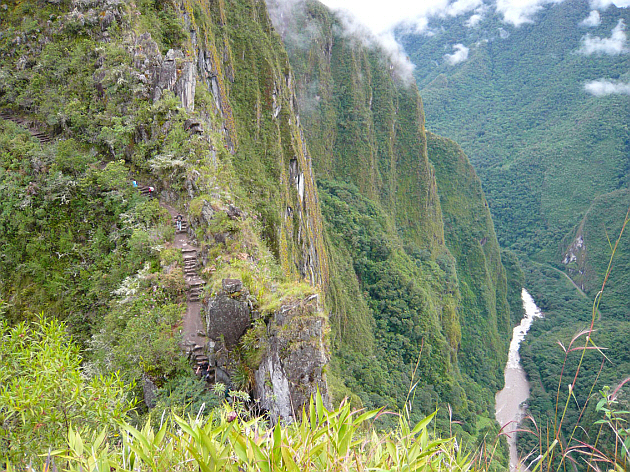
The trail leading up to Huayna Picchu and the Urubamba Valley below on the right side
Agricultural Terraces
There are some agricultural terraces on Huayna Picchu too. Some of these are very close to the edge of the cliff, so don't even try walking out there on them!
The Temple of the Moon/Moon Temple
Behind the summit you will find a route to the Temple of the Moon, which is "installed" in a natural cave.
Visiting the Temple of the Moon takes about 1 hour. Because it is not exactly on the top of Huayna Picchu, but slightly below it. You will have to walk downwards and after that even climb a little bit.
There will be 2 ways down: a short, but steeper, scarier way and a longer, but less dangerous path.
The Great Cave
This can be reached from Huayna Picchu after descending. It can be a difficult hike, through a deep forest, an abrupt road. Plaques/signs will tell you where the direction to the "Gran Caverne".

No comments:
Post a Comment